
Drone Search for Missing Pets
If your pet is missing, start searching on foot and reporting straight away. Where the likely area is large or open, a professional drone search may help you see ground that is slow or unsafe to walk. This page explains what it can add, when it does not suit, and how to arrange one, whether you pay privately or have Pet Search cover.
Drone searches powered by Drone Assisted
£240 including VAT
No insurance needed. Continue to Drone Assisted, the professional drone pilot network behind Pet Search, to create your account, book and pay for your private search.
Subject to suitability, pilot availability, weather, airspace and safety. Finding your pet cannot be guaranteed.
Last reviewed 23 October 2026
The pilot network behind your search
Pet Search provides missing pet guidance and a route to search support. Drone Assisted provides the professional drone pilot network behind the searches. A private booking continues on their website because you book and pay directly with Drone Assisted.
- 1
Start with Pet Search
Explore the guidance and check whether a drone could help in your area.
- 2
Book with Drone Assisted
Create an account, share your pet and location details, and check the total before you pay.
- 3
Your search is assessed
Suitability, conditions and pilot availability are checked before a pilot can be sent.
Continue to Drone Assisted. £240 including VAT. No insurance needed.
Choose the right route
- Not sure a drone would help? Use the free drone search checker. It takes a couple of minutes and needs no account.
- No Pet Search cover? You can book a private drone pet search with Drone Assisted, the professional drone pilot network behind Pet Search. Booking and payment continue on their website. No policy is needed.
- Have Pet Search cover? Make a claim. Your cover is checked before a search is arranged, and your policy terms apply rather than the private booking terms below.
See how a drone pet search works
An aerial view can help search open ground and areas that are difficult to cover on foot. Watch the search process, then check whether a drone could help in your situation.
Captions are available in the player. Watch on YouTube (opens in a new tab)
What aerial searching can add
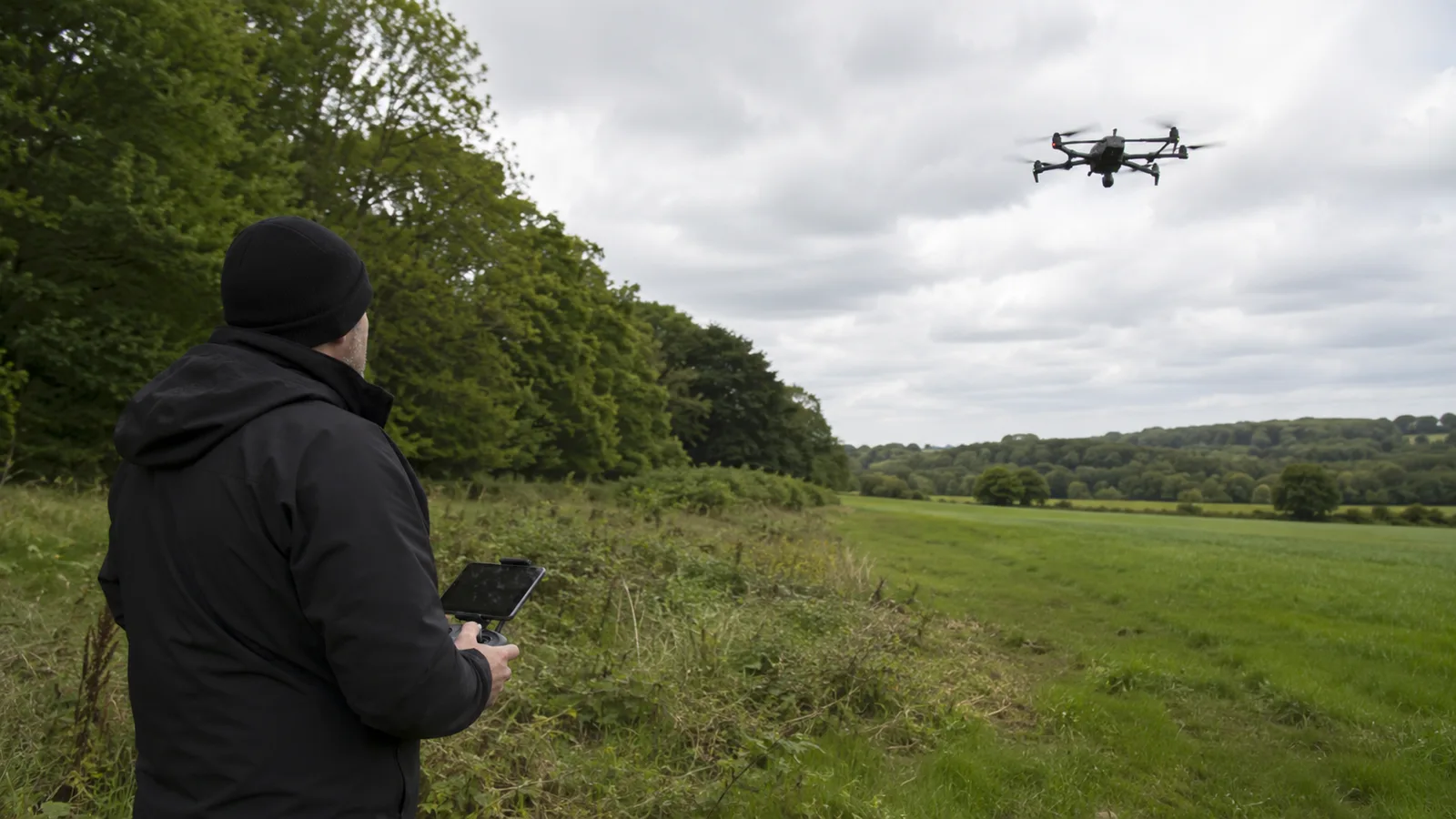
A drone pet search is an aerial search of an agreed area carried out by a professional pilot, who watches a live camera feed looking for the animal or for anything worth checking on the ground. It lets you look across fields, rough ground and woodland edges far faster than walking them, and it can reach places that are unsafe to enter on foot.
It is a search tool, not a locator. It adds another way of looking. It does not replace searching on foot, calling, posters or reports to microchip databases, and it does not guarantee a pet will be found.
Situations that may suit a drone
- There is a reasonably defined area, based on the last confirmed sighting or recent reports.
- The pet may be in fields, farmland, moorland, scrub or open countryside, where conditions suit an aerial search.
- The ground is large, difficult or unsafe to cover on foot.
- Tracks, clearings and woodland edges, covered in drone search in woodland.
- Weather, light and airspace allow a safe, legal flight.
Situations that do not suit a drone
- The pet is likely to be inside or under something: a shed, garage, vehicle, decking or a building.
- Dense tree canopy or thick vegetation hides the ground, since thermal cameras cannot see through trees.
- Built up areas with many covered hiding places, which is common for missing cats.
- High wind, heavy rain, fog, restricted airspace or no safe place to take off and land.
- There is no meaningful idea of where the pet may be.
Thermal cameras cannot see through roofs, walls, sheds, vehicles, trees or dense cover. A warm spot may be another animal or a warm object, and thermal imaging never guarantees detection.
What happens before a pilot can be sent
See how a drone search works for more detail.
- You give the details: the last confirmed location and time, recent sightings, a photograph and a description of your pet.
- The request is checked for suitability, including airspace, weather, terrain, access and safety.
- A local professional pilot from the Drone Assisted network is matched, subject to availability.
- The pilot agrees a search area with you and keeps the drone within visual line of sight.
- If your pet is seen, the pilot lands safely and shares the location. Catching or physically recovering your pet is not included.
Private searches and Pet Search claims are different
A private search is booked and paid for directly with Drone Assisted, the UK professional drone pilot network behind Pet Search. You continue on the Drone Assisted website, create an account as part of booking and see your total before you pay. No insurance policy is needed.
A Pet Search claim is for customers who already hold Pet Search cover. The claim route checks your cover first and your policy terms set what is provided. The private booking price and terms on this page do not apply to claims and do not change what a policy includes.
Private search price and what is included
- Price: £240 total including VAT (£200 plus £40 VAT). One fixed price for a private search, with no extra booking fee. Your total is shown again before payment.
- A minimum of one hour of actual airborne searching.
- Searching may continue up to a maximum of two hours of total flight time where further searching is appropriate, subject to battery charge, safe operating reserves, weather, airspace, site access and other conditions. Two hours cannot be guaranteed.
- Flight time can be built up across several flights. Travel, parking, preparation, discussions, battery changes and charging do not count towards it.
- A search may finish early if your pet is found, you ask for it to stop, Drone Assisted reasonably stands the assignment down, continued flying would be unsafe or unlawful, or the pilot reasonably decides further searching would serve no useful purpose. The reason is explained and recorded.
- Visual camera searching is included. Thermal imaging is included only where it is expressly confirmed for your booking, because not every pilot carries thermal equipment.
Price and terms are those published by Drone Assisted for private pet searches at the time of review. Always check the total shown before you pay.
Drone searches powered by Drone Assisted
£240 including VAT
No insurance needed. Continue to Drone Assisted, the professional drone pilot network behind Pet Search, to create your account, book and pay for your private search.
Subject to suitability, pilot availability, weather, airspace and safety. Finding your pet cannot be guaranteed.
Is drone search safe and legal?
Professional searches operate within UK drone rules and any local airspace restrictions. If the location or conditions do not allow a safe, legal flight, the search cannot go ahead in that form. Light and weather are covered in best conditions for a drone search, and after dark in night drone search.
Missing dog or missing cat?
The two searches are different. A dog moving across open ground is often better suited to aerial searching than a cat, which is usually searched for in hiding places close to home, although this varies. See drone search for missing dogs and drone search for missing cats.
Sources and further reading
Related guides
Drone searches powered by Drone Assisted
£240 including VAT
No insurance needed. Continue to Drone Assisted, the professional drone pilot network behind Pet Search, to create your account, book and pay for your private search.
Subject to suitability, pilot availability, weather, airspace and safety. Finding your pet cannot be guaranteed.
Work for an insurer, broker or MGA? Offer Pet Search to your customers